How to Build a Professional Website in Morocco in 2026
Published on July 8, 2026
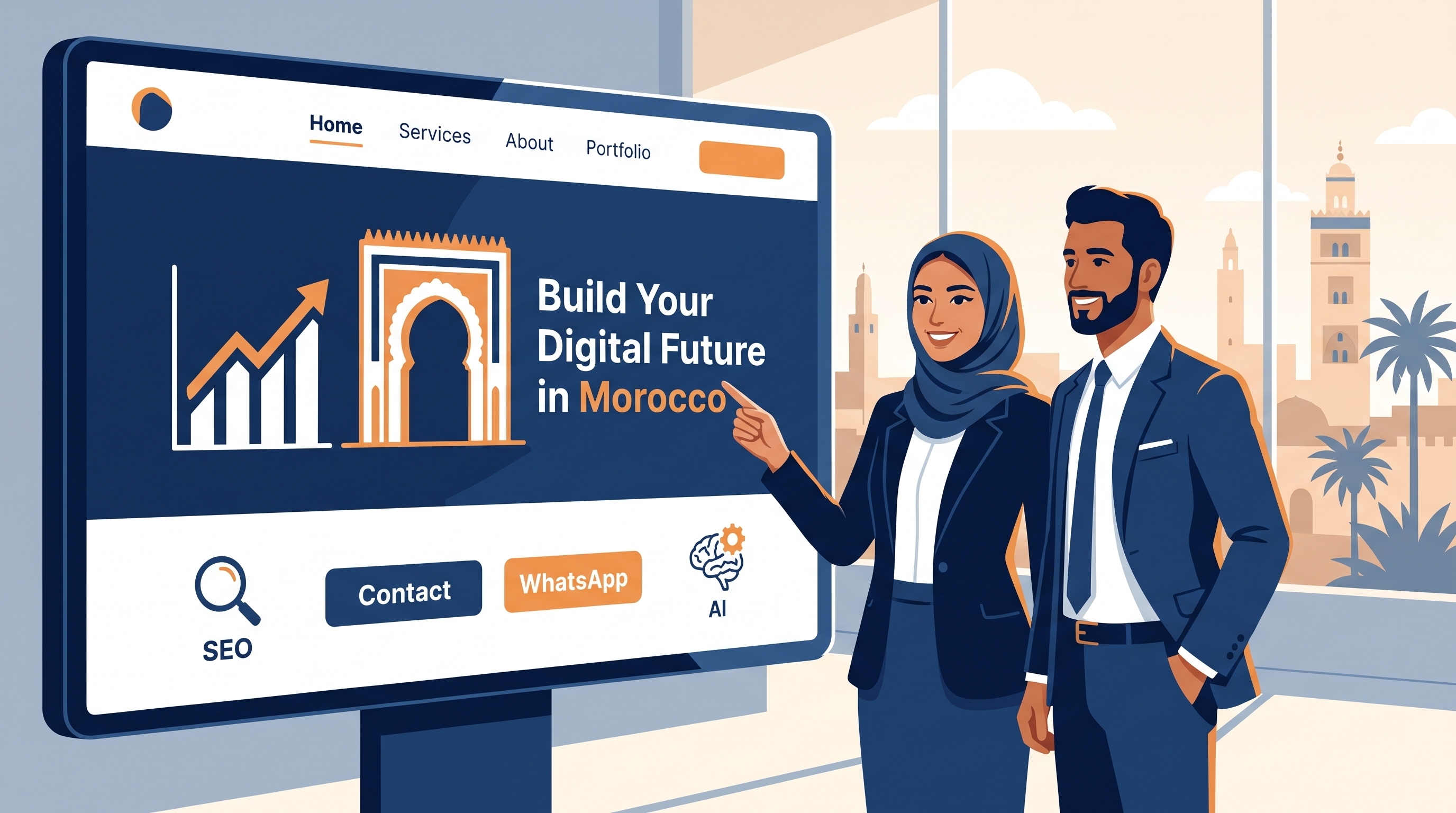
Having a professional website in Morocco in 2026 is no longer a luxury – it is a core asset for credibility and growth for individuals, very small businesses (TPE) and small/medium enterprises (SME). Market studies and local SEO guides consistently show that companies that structure their digital presence (website + SEO + Google Business Profile + a layer of AI) attract more leads at a more stable acquisition cost than those relying only on social media or occasional ads.
This article walks through a clear, Morocco‑specific roadmap to move from “I only have a Facebook/Instagram page” to “I have a website that actually generates client requests.”
1. Understanding the Moroccan digital context in 2026
In Morocco, most traffic is mobile and most search goes through Google, which makes the trio “fast website + local SEO + Google Business Profile” essential to be visible. 2026 website guides for Moroccan businesses emphasize three key decisions:
- Choosing the right format (vitrine site, landing page, e‑commerce, web app).
- Ensuring solid technical performance (Core Web Vitals, HTTPS, mobile‑first).
- Integrating SEO from the start, not as an afterthought.
Price ranges reported by agencies go from around MAD 3,000 for a very basic vitrine site to MAD 15,000–80,000 for complex projects (e‑commerce, custom solutions). This is why clarifying business objectives before signing any web project is non‑negotiable.
2. Step 1 – Clarify objectives and audience
Before talking about design or tech, answer a few simple but strategic questions:
- Is your primary goal credibility (serious presence) or lead generation (requests, bookings, quote inquiries)?
- Is your audience mainly local (city / district / region) or national / international?
- Do you primarily sell services or products?
SEO guides for Moroccan SMEs emphasize that your site structure (service pages, forms, CTAs) must be built around these business outcomes.
3. Step 2 – Choose the right site format
Local resources recommend choosing the site format before choosing tools or CMS:
- Vitrine site – ideal for liberal professions, restaurants, salons, clinics, agencies.
- Landing page – perfect for a single offer, campaign or lead‑generation funnel.
- E‑commerce site – for direct product sales.
- Web app / SaaS – when your service itself is digital and advanced.
Picking a format that is more complex than necessary drives up costs and timelines without guaranteeing ROI.
4. Step 3 – UX and web design adapted to Morocco
Web design trends in Morocco in 2026 show that minimalism, generous white space and a clear visual hierarchy perform best with local users. Dark mode and micro‑interactions are gaining popularity for more digital audiences.
Practically, for a Moroccan professional website:
- Use a clean, readable layout, with mobile‑first design.
- Optimize loading speed – connections and devices vary across regions.
- Use a visual identity that reflects your brand and culture, without overcomplication.
5. Step 4 – Build basic SEO and local SEO
SEO in Morocco rests on three pillars:
- Technical SEO – HTTPS, speed, clean HTML structure, mobile‑first.
- Content – clear service pages, an “About” page, and articles or guides that answer real client questions.
- Local SEO – a well‑optimized Google Business Profile, consistent NAP (Name, Address, Phone), and “service + city” pages.
Multiple Moroccan guides consider Google Business Profile to be the backbone of local visibility in Google Maps and “near me” searches.
6. Step 5 – Use AI intelligently, not blindly
Articles on “SEO and AI in Morocco” explain that AI can help at several levels:
- Suggesting keywords and building topic clusters.
- Drafting content (which you then refine with local examples and tone).
- Running simplified technical audits.
- Powering chatbots and automated responses on the site or via WhatsApp.
The point is not to let AI “replace” the business owner, but to use it as an assistant for writing, analysis and automation.
7. Step 6 – Agency vs DIY with AI
It is true that AI‑powered tools can now create simple sites, but serious projects that require strong SEO, UX, legal compliance (CNDP) and integration with business systems still benefit greatly from agency support.
A realistic path for a Moroccan TPE/SME is:
- Build a solid digital base with an agency (site, SEO, Google Business, analytics).
- Add AI layers progressively (chatbots, automation, AI‑assisted content).
This way, “digital presence” evolves into “augmented intelligence” that serves business results, not just a tech toy.
8. FAQ – Professional website in Morocco (10 questions)
Q1. Do I really need a website if I already have Facebook/Instagram?
Social networks are useful, but they do not replace a structured website + local SEO, especially for appearing on Google and Google Maps and building long‑term credibility.
Q2. Which type of site is best for a small service business?
In most cases, a simple vitrine site or a focused landing page with contact and WhatsApp CTAs is enough to start.
Q3. What is the average cost of a vitrine site in Morocco in 2026?
Most grids mention ranges around MAD 3,000–5,000 for a simple vitrine site, with higher prices for more customized projects.
Q4. How long does it take to launch a site?
Typical estimates: 1–2 weeks for a landing page and 2–4 weeks for a full vitrine site, if content is delivered on time.
Q5. Is SEO really useful for a small local business?
Yes. SEO – especially local SEO – is often the most profitable acquisition channel over the medium term for Moroccan SMEs.
Q6. What can AI do for my website?
It can assist with content creation, keyword research, performance analysis and simple client support via chatbots or automated FAQs.
Q7. Can I build the site myself using AI tools only?
You can for simple sites, but for serious projects, an agency remains important for quality, strategy and integration.
Q8. How do I know if my site is “professional enough”?
Look at performance, clarity, credibility (real photos, reviews, case studies) and whether it actually generates inquiries and bookings.
Q9. Is a website useful for freelancers and independent professionals?
Yes. It acts as a digital business card, showcasing expertise, portfolio and making direct contact easier.
Q10. What does an agency like Web Service add versus a DIY site?
An agency combines design, SEO, local presence and AI integration to turn visibility into measurable business results.


Comments
Be the first to comment on this article.
Leave a Comment